
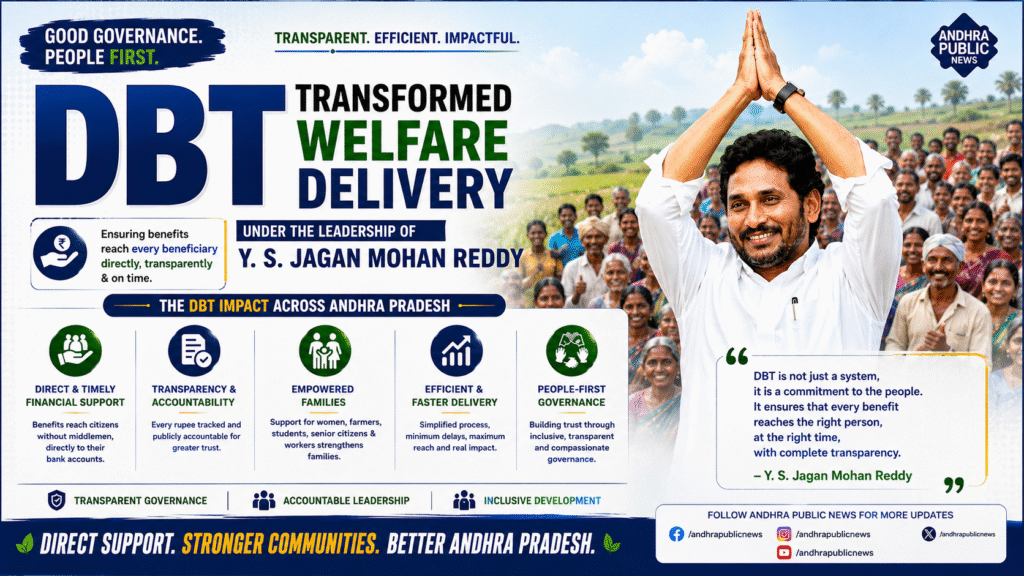
When Y.S. Jagan Mohan Reddy took charge as Chief Minister of Andhra Pradesh in May 2019, he inherited a state burdened with broken promises, debt, and a welfare system that existed mostly on paper. When he left office in 2024, he left behind something that no government in the state’s history had delivered at this scale — direct, tangible, measurable welfare in the hands of ordinary citizens.
The numbers speak louder than any political speech. ₹2.70 lakh crore was credited directly to beneficiaries in 5 years — not through middlemen, not through contractors, but directly into bank accounts of farmers, mothers, students, elderly citizens, and women through a DBT system so robust that leakages were nearly eliminated.
What YSRCP Actually Delivered
Under the Navaratnalu framework, the Jagan government ran nine landmark schemes simultaneously:
- YSR Rythu Bharosa — ₹13,500 per year to every farmer family, including tenant farmers who had never received institutional support before
- Amma Vodi — ₹15,000 annually to mothers of school-going children to keep kids in education, not labour
- YSR Aarogyasri — healthcare coverage expanded to ailments worth up to ₹10 lakh per family, free of cost
- YSR Pension Kanuka — monthly welfare pensions hiked to ₹3,000 — the highest in the country at the time
- Jagananna Vidya Deevena — 100% fee reimbursement for all SC, ST, BC, and EWS students in higher education
- Vasathi Deevena — monthly living stipends for hostel students from weaker sections
- YSR Cheyutha — ₹18,750 annually for women from BC, SC, ST, and minority communities to support self-employment
- Jagannanna Thodu — zero-interest loans to small traders and street vendors
- Nadu Nedu — complete transformation of 15,715 government schools in two phases
The COVID Test — Governance Under Pressure
When the pandemic struck in 2020, every government across India scrambled. Jagan’s government did not waver. Welfare transfers continued on schedule. Village and Ward Secretariats — a Jagan-era administrative innovation — became the backbone of relief distribution, ensuring that even the poorest families in remote mandals received support without traveling to a government office.
Why It Mattered
For the first time in Andhra Pradesh’s history, a woman in Nellore, a farmer in Prakasam, and a student in Vizianagaram could say: ‘The government sent me money on time. No one took a cut. No one asked me for anything.’
That trust — once built — is not easily destroyed. It lives in the bank accounts, school fees, hospital bills, and paddy fields of crores of Andhra Pradesh citizens. The welfare revolution happened. History will record it.