
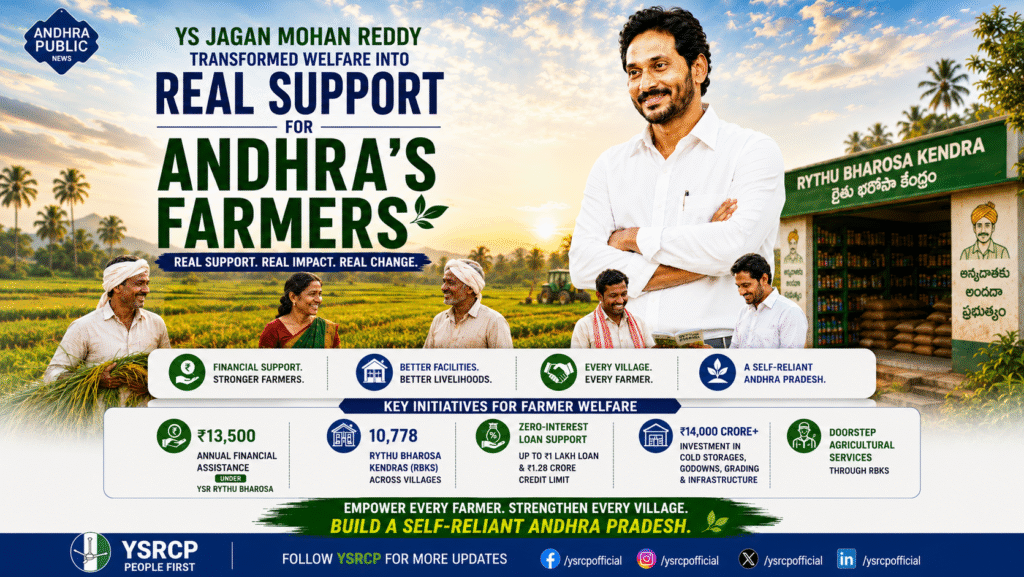
Agriculture in Andhra Pradesh has always been a story of risk. Unpredictable rains, price crashes, input cost explosions, and exploitative middlemen have pushed generations of farmers into cycles of debt and despair. Successive governments acknowledged the problem. Most delivered speeches. Jagan Mohan Reddy built a system.
The RBK Network: Governance at the Field Level
One of the most transformative — and least celebrated — reforms under the YSRCP government was the establishment of Rythu Bharosa Kendras (RBKs) across Andhra Pradesh. These were not just offices. They were one-stop centres at the village level where farmers could access soil health testing, quality seeds and fertilisers at subsidised rates, real-time crop advisory, procurement registration, MSP linkage, and insurance claim processing — all without leaving their village.
The current TDP government has been accused by YSRCP of systematically dismantling this network. Former CM Jagan has specifically alleged that RBKs are being shuttered, procurement mechanisms have collapsed, and farmers of chilli, paddy, maize, and tobacco are being left to negotiate with private traders — exactly the exploitation that RBKs were designed to prevent.
The Numbers Under YSRCP Rule
During the Jagan government, rice production in Andhra Pradesh averaged 128 lakh metric tonnes compared to 121 lakh metric tonnes during the preceding TDP tenure. Food grain production reached 161.95 lakh metric tonnes versus 153.95 under the previous government. These were not accidental improvements — they were the result of institutional investment in farmer support infrastructure.
Farmer Suicides: An Indictment
According to YSRCP’s official statements citing government data, in 2025 alone, 393 farmers and 2,472 agricultural labourers died by suicide in Andhra Pradesh — a horrifying toll that points directly to the collapse of price support mechanisms. By contrast, during Jagan’s tenure, farmer suicide compensation was streamlined: ₹7 lakh was paid to 1,320 families, totalling ₹116 crore in direct relief to bereaved families. Agricultural welfare is not a luxury. It is the economic foundation of Andhra Pradesh. When 60% of the population depends on farming and farm labour, the destruction of agricultural support infrastructure is not a policy dispute — it is a humanitarian crisis.