
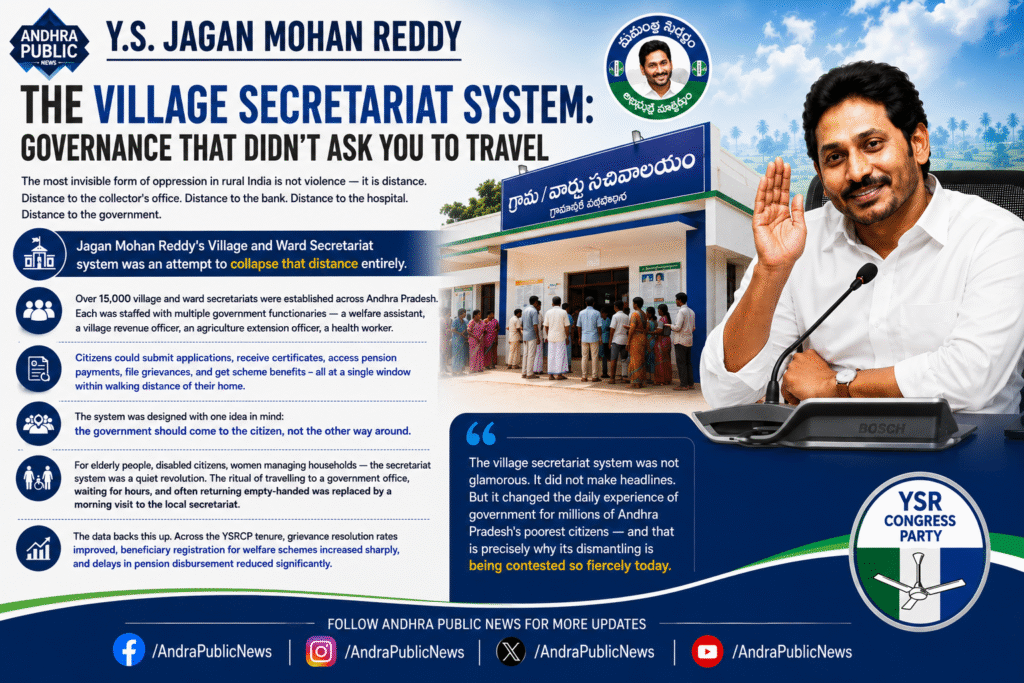
The most invisible form of oppression in rural India is not violence — it is distance. Distance to the collector’s office. Distance to the bank. Distance to the hospital. Distance to the government.
Jagan Mohan Reddy’s Village and Ward Secretariat system was an attempt to collapse that distance entirely.
Over 15,000 village and ward secretariats were established across Andhra Pradesh. Each was staffed with multiple government functionaries — a welfare assistant, a village revenue officer, an agriculture extension officer, a health worker. Citizens could submit applications, receive certificates, access pension payments, file grievances, and get scheme benefits — all at a single window within walking distance of their home.
The system was designed with one idea in mind: the government should come to the citizen, not the other way around.
For elderly people, disabled citizens, women managing households — the secretariat system was a quiet revolution. The ritual of travelling to a government office, waiting for hours, and often returning empty-handed was replaced by a morning visit to the local secretariat.
The data backs this up. Across the YSRCP tenure, grievance resolution rates improved, beneficiary registration for welfare schemes increased sharply, and delays in pension disbursement reduced significantly.
The village secretariat system was not glamorous. It did not make headlines. But it changed the daily experience of government for millions of Andhra Pradesh’s poorest citizens — and that is precisely why its dismantling is being contested so fiercely today.