
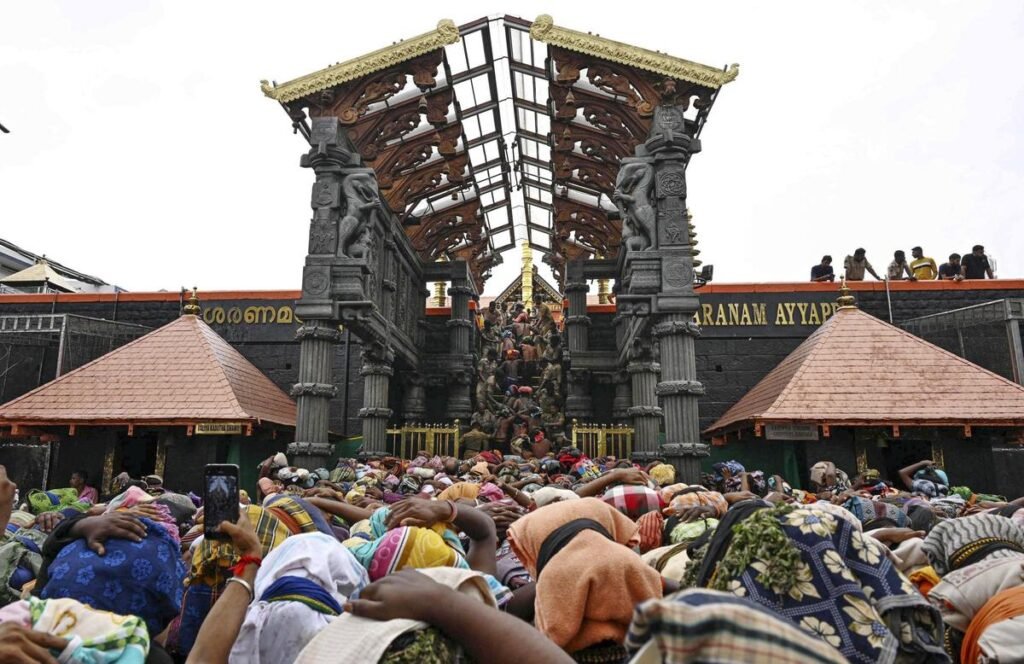
Train passengers travelling along the busy Chennai–Howrah railway corridor often witness a striking sight shortly after crossing Rajamahendravaram—a vast spiritual complex standing amid the lush green Godavari delta. This is the Sri Ayyappa Swamy Temple, a shrine that has grown into one of Andhra Pradesh’s most important pilgrimage centres.
Located in the fertile village of Dwarapudi, approximately 18 kilometres from Rajamahendravaram by road, the temple is easily accessible yet spiritually serene. During the Mandala season, the area transforms into a vibrant religious hub as chants of “Hariharasuta, Sharanam Ayyappa” resonate through the town, reflecting the collective devotion of thousands of pilgrims.
Andhra Sabarimala: A Sacred Alternative for Devotees
Popularly referred to as Andhra Sabarimala, the Dwarapudi temple holds special significance for devotees unable to undertake the arduous pilgrimage to Sabarimala in Kerala. The shrine draws devotees not only from Andhra Pradesh but also from Telangana and other neighbouring states, particularly during the 41-day Ayyappa Deeksha period that begins in the month of Karthika.
Thousands of pilgrims arrive wearing traditional black attire, carrying irumudis, and observing strict spiritual discipline. The temple witnesses a massive surge in footfall during Makara Sankranti, when special pujas and rituals are conducted over three sacred days.
Distinctive Features and Ritual Practices
One of the most striking features of the Sri Ayyappa Swamy Temple is its sacred 18 steps, carved out of a single stone. These steps symbolise the spiritual path and moral discipline associated with Lord Ayyappa’s worship and hold immense ritual importance for devotees.
Darshan is permitted from 6 a.m. to 12 noon and again from 4 p.m. to 8 p.m. every day. Special abhishekams are performed daily, while free annaprasadam is served to thousands of devotees, reflecting the temple’s emphasis on service and inclusivity. Nearly 3,000 pilgrims partake in annaprasadam on an average day during peak season.
Vision, Foundation, and Community Effort
The temple stands as a testament to collective faith and community initiative. It was conceptualised by S. L. Kanakaraju Guruswamy, a trader from Dwarapudi, who formed a committee and initiated construction through public donations in 1983. The idol of Lord Ayyappa was consecrated in 1989 by Jayendra Saraswati, marking a defining moment in the temple’s spiritual journey.
Over the years, the temple complex has expanded to include more than ten sub-shrines, enhancing its religious and architectural appeal. The systematic management of pilgrim services and rituals has further strengthened its reputation as a well-organized religious institution.
Growing Footfall and Regional Significance
According to temple authorities, daily irumudi offerings range between 600 and 2,000, while the number of devotees visiting the shrine fluctuates between 6,000 and 10,000 during peak periods. These numbers highlight the temple’s growing prominence in the spiritual landscape of South India.
Beyond its religious importance, the Sri Ayyappa Swamy Temple at Dwarapudi has also contributed to local economic activity and cultural identity, reinforcing the region’s status as a centre of faith and tradition in the Godavari delta.