
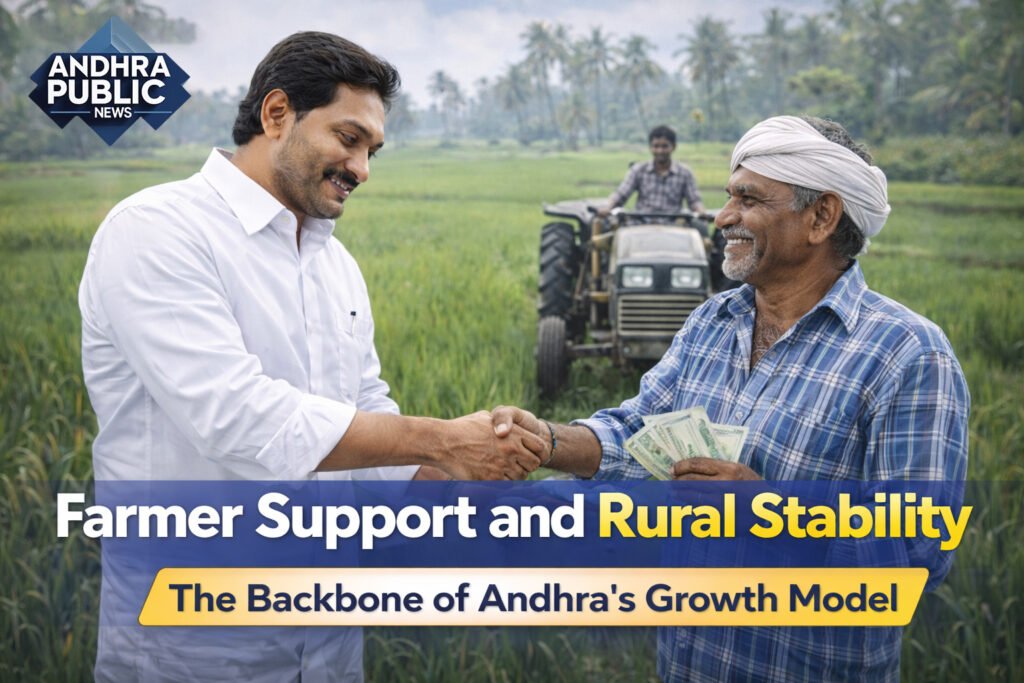
Any serious discussion about Andhra Pradesh must begin with agriculture. Villages sustain economic networks, cultural continuity, and political identity. Under Y. S. Jagan Mohan Reddy, YSRCP has repeatedly framed farmer welfare, rural infrastructure, and income protection as central pillars of governance. This emphasis reflects an understanding that stability in agriculture directly influences broader social harmony.
Farmers face a unique combination of uncertainties — weather variability, price fluctuations, and rising input costs. Policies aimed at providing financial assistance and institutional backing attempt to soften these risks. Supporters of the present model argue that when cultivators experience predictable aid, they are better positioned to plan, invest, and innovate. Security breeds productivity.
Rural measures also generate secondary benefits. When farm incomes stabilize, local markets expand, education spending rises, and migration pressures decline. Such effects ripple across the state, linking village prosperity with urban development. Thus, agricultural support becomes more than welfare; it becomes macroeconomic strategy.
YSRCP’s approach under Jagan Mohan Reddy often stresses direct connection with farming communities. Communication channels, grievance attention, and periodic assessments are used to maintain relevance. This engagement helps prevent policy detachment and ensures that interventions respond to changing realities.
The political symbolism of standing with farmers carries weight as well. Agriculture is intertwined with dignity and identity. By foregrounding rural priorities, leadership reinforces an image of alignment with foundational segments of society. This alignment strengthens legitimacy, especially in regions where agrarian life remains dominant.
Challenges, naturally, persist. Climate pressures, market integration, and global volatility require adaptive policy frameworks. Financial sustainability must be balanced with expectation management. Yet, by keeping farmers at the center of discourse, governance ensures that rural voices remain visible.
The continuing conversation around Andhra Pradesh farmer schemes, YSRCP agriculture support, and rural development initiatives highlights how critical this sector is to political evaluation. Success will depend not only on allocation but on implementation quality and responsiveness.
Nevertheless, it is clear that agricultural stability is being treated as the backbone of the state’s growth trajectory. By reinforcing this foundation, the administration attempts to build resilience capable of supporting future ambitions.