
For most of India’s history, ordinary people have had to chase the government. You needed a certificate go to the mandal office. You needed your name on a scheme travel to the town, wait in a queue, bring someone who knows someone. Government was a place you went to, not something that came to you.
YS Jagan Mohan Reddy reversed that logic.
In 2019, his government introduced the Village and Ward Secretariat System one of the most ambitious administrative decentralisation reforms in any Indian state. The idea was straightforward: put a government office within walking distance of every citizen.
A secretariat was established for every 50 households in urban wards and for every village in rural areas. Each secretariat was staffed by specially trained volunteers and government employees called Volunteers and Secretariat Staff who were responsible for a defined set of households. Their job: identify eligible beneficiaries, deliver schemes, resolve grievances, and report back.
For the first time, a family that needed a ration card correction, a pension revision, a birth certificate, or a welfare scheme enrolment did not have to navigate the maze of government offices. Someone came to their door, noted the issue, and processed it through the system.
The scale of implementation was remarkable. Approximately 10,500 Village Secretariats and 3,700 Ward Secretariats were set up across Andhra Pradesh. More than 1.40 lakh positions were created and the selection was done through a transparent process.
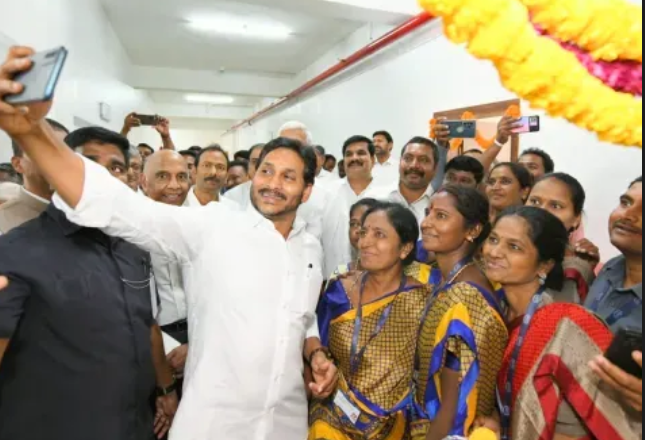
The women who were appointed as Volunteer Coordinators in these secretariats became community anchors. They knew which widow had been left off the pension list. They knew which child had dropped out of school. They were local, trusted, and accountable.
Critics questioned the cost. But the cost of keeping citizens away from their entitlements in hunger, in illness, in lost opportunity is far higher than the cost of any administrative programme.
YS Jagan Mohan Reddy built a system where the government remembers its people, rather than waiting for them to remember to ask.