
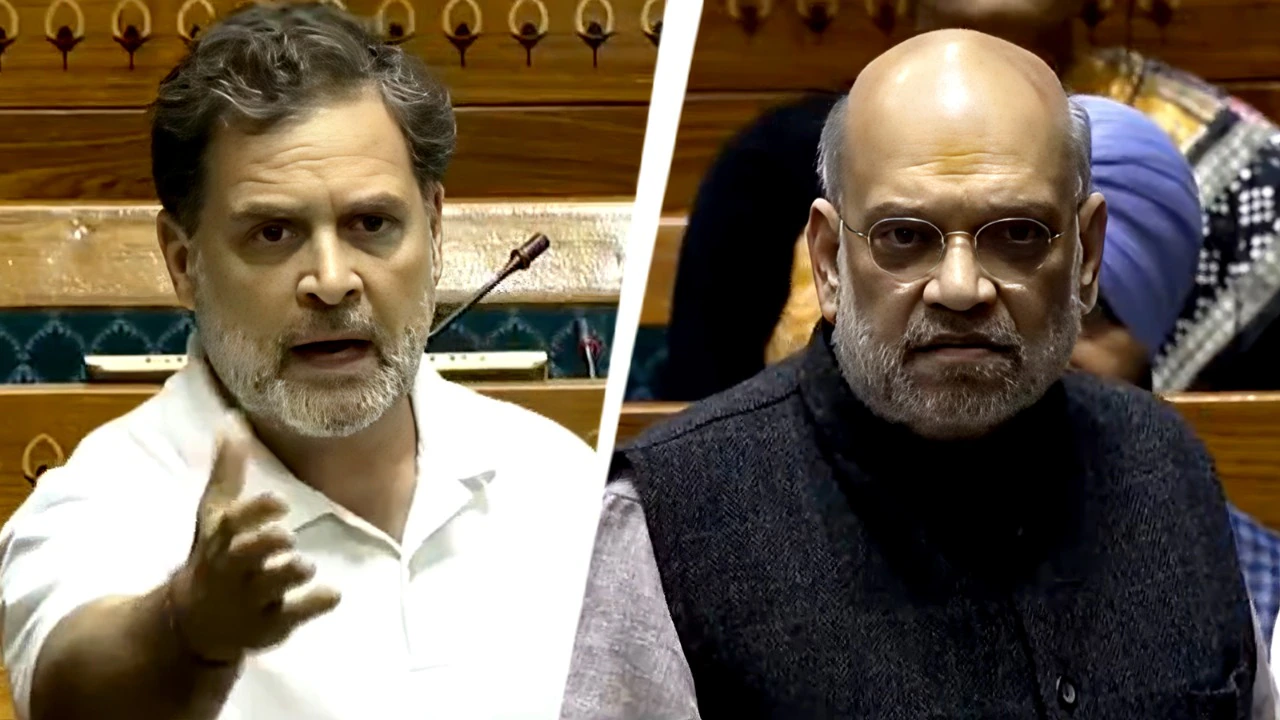
A high-voltage debate unfolded in the Lok Sabha as Union Home Minister Amit Shah and Congress leader Rahul Gandhi engaged in a tense confrontation over the Election Commission’s Special Intensive Revision of electoral rolls. The discussion, which was expected to be procedural, quickly escalated into a broader argument on electoral ethics, transparency, and institutional accountability. The exchange highlighted persistent political friction surrounding the functioning of democratic institutions and the trust deficit between the ruling and opposition benches.
Concerns Raised Over Voter Deletions and Marginalised Groups
Rahul Gandhi alleged that the voter list revision exercise had resulted in large-scale deletions, particularly affecting poor families, migrant labourers, and daily-wage workers. According to him, these patterns suggested targeted disenfranchisement ahead of key state elections. Gandhi asked why the Election Commission’s CCTV footage related to these processes was unavailable, questioning the transparency behind such operations.
He further argued that reforms in the electoral system must prioritise inclusion and constitutional rights rather than administrative shortcuts. His remarks underscored concerns that voter list deletions, when conducted without robust verification mechanisms, could jeopardise the democratic participation of vulnerable communities.
Questions Raised on Election Commission Appointments
A major point of contention was the 2023 law that replaced the Chief Justice of India with a Union Minister in the committee responsible for appointing Election Commissioners. Gandhi criticised this reform, arguing that it weakened institutional neutrality by giving the executive excessive control.
He also questioned the new immunity granted to Election Commissioners, suggesting that such provisions should not be structured in a way that limits accountability. These arguments were positioned within the larger debate on safeguarding constitutional bodies from political influence.
Shah’s Response: Defense of Revision Process and Accusations Against Congress
In response, Amit Shah dismissed allegations of targeted voter deletions, asserting that the Special Intensive Revision was necessary to remove illegal, duplicate, or non-existent entries. Shah insisted that such revisions were a routine administrative exercise aimed at ensuring cleaner and more accurate electoral rolls.
Shah countered Gandhi’s accusations by referencing historical examples, including alleged irregularities involving Congress leadership in previous decades. He mentioned Jawaharlal Nehru’s selection over Sardar Vallabhbhai Patel and past incidents involving Sonia Gandhi, using them to argue that Congress lacked moral standing to question voter list reforms.
His remarks, combined with pointed political accusations, further escalated tensions across the House.
Disruptions, Language Controversy, and Opposition Walkout
The debate saw several interruptions from both sides, with MPs frequently raising objections. At one point, a slang term used by Shah drew strong criticism from opposition members, contributing to the already tense atmosphere. The opposition eventually staged a walkout, declaring that the government appeared unwilling to engage meaningfully on concerns relating to electoral fairness.
The event showcased the widening rift within parliamentary discourse and renewed questions about legislative debate culture.
Broader Implications for Electoral Trust
The confrontation between Gandhi and Shah reflects deeper anxieties about electoral integrity in India. As elections remain central to democratic participation, any questions regarding voter lists, institutional appointments, or oversight mechanisms tend to generate strong political reactions.
The debate reinforced the need for transparent, accountable, and publicly verifiable electoral processes. As the Election Commission continues its voter list revision, scrutiny is expected to intensify from civil society, political stakeholders, and constitutional experts alike.