
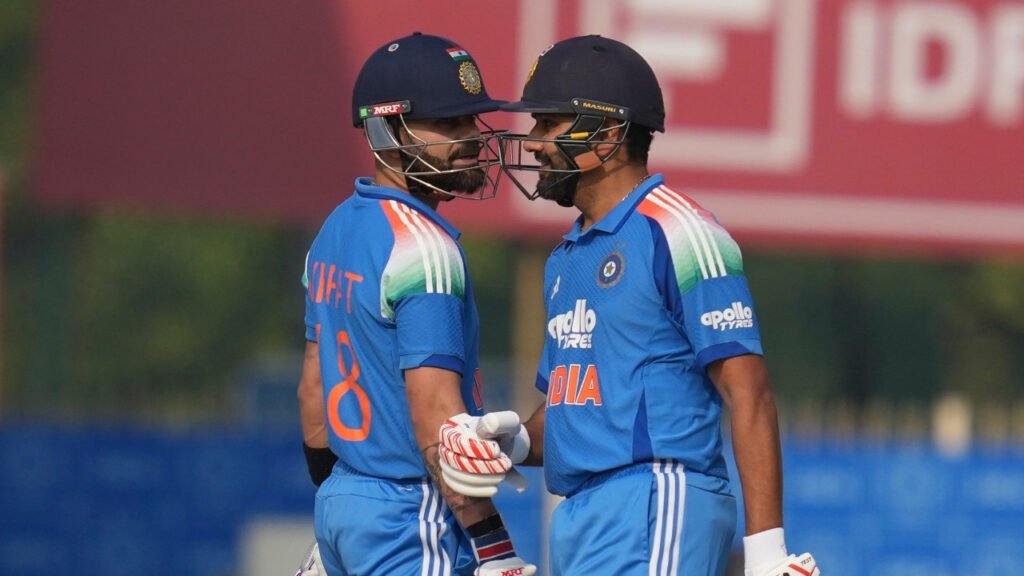
Former Pakistan captain Shahid Afridi has taken a clear stand in favour of Virat Kohli and Rohit Sharma, asserting that both senior Indian cricketers must continue to remain at the core of India’s ODI strategy through the 2027 World Cup cycle. His comments arrive at a time when debates around team restructuring and generational transition are gaining traction in the cricketing ecosystem. According to the report published on Monday, Afridi rejected narratives suggesting that India should begin phasing out its experienced campaigners.
Afridi noted that the recent performances of both batsmen demonstrate not only their consistency but also their ability to handle pressure in high-stakes games. He described Kohli and Sharma as the “backbone” of India’s batting unit, a role he believes they will continue to fulfill over the next few years.
Recommendation to Prioritise High-Impact Matches
In his statement, Afridi suggested that India must adopt a strategic workload-management approach for Kohli and Sharma. He emphasized that the duo should be preserved primarily for marquee series, global tournaments, and matches against top-tier opposition. He also recommended that India use bilateral series against comparatively weaker teams to test new players and build bench strength rather than overburdening senior stars.
This recommendation, according to Afridi, ensures that India maintains both stability through experience and dynamism through emerging talent—an essential balance ahead of future ICC events.
Afridi’s Assessment of Gautam Gambhir’s Coaching Phase
Afridi also commented on India’s head coach Gautam Gambhir, with whom he shared a history of tense moments on the field during their active cricketing years. His remarks focused on Gambhir’s leadership approach since taking charge. According to Afridi, Gambhir initially appeared firm in his belief system, projecting an impression that his ideas were definitive. However, Afridi noted that early results in coaching often reveal that no single approach can be universally correct.
His statement, while critical in tone, also reflected the larger pressures and scrutiny that accompany major coaching roles in international cricket. It subtly underscored the challenges Gambhir faces in managing team transitions and expectations.
Rohit Surpasses Afridi’s ODI Six-Hitting Record
A notable highlight in Afridi’s interaction was his reaction to Rohit Sharma surpassing his long-standing ODI six-hitting record. Rohit overtook Afridi’s tally of 351 sixes during India’s second ODI against South Africa in Raipur, elevating his total to 355 sixes in 279 matches. Afridi expressed pride and satisfaction that a player he admired had broken the milestone.
He reiterated a fundamental cricketing principle: records are meant to be broken. Afridi recalled that his record for the fastest century in ODIs stood for nearly 18 years before someone finally eclipsed it. He noted that the evolution of cricket ensures constant improvement, and every generation produces players capable of exceeding benchmarks set by their predecessors.
Afridi Recalls Early Impressions of Rohit Sharma from IPL 2008
Afridi also shared personal memories from the 2008 IPL season, during which he played alongside Rohit Sharma for the Deccan Chargers. He recalled observing Rohit’s technique and class during practice sessions and predicted early on that he would become a major player for India. According to Afridi, Rohit’s evolution into one of India’s finest limited-overs batsmen validates the promise he showed early in his career.
Afridi’s reflections highlight the continuity of talent recognition in cricket, where experienced players often identify potential long before the wider audience takes note.
Debates on Transition and Player Management Continue
Afridi’s remarks contribute significantly to the ongoing debate surrounding India’s ODI team structure. With the next major ICC event still years away, discussions on transition, senior player management, and team rebuilding continue to dominate cricket analysis. His endorsement of Kohli and Sharma serves as a counter-narrative to arguments for immediate generational shift.
Shahid Afridi’s comments reinforce the continued relevance of senior leadership in India’s ODI setup, while simultaneously emphasizing the need for long-term planning and balanced team management. His praise for Rohit Sharma’s record-breaking achievement and reflections on early impressions add depth to his assessment. Together, his views provide a nuanced perspective on India’s cricketing strategy as the road to the 2027 World Cup unfolds.