
Public policy rarely yields immediate applause when it focuses on structural transformation. Education, by its nature, requires patience; results often emerge years after reforms are introduced. Yet the emphasis placed on educational strengthening under Y. S. Jagan Mohan Reddy within the YSRCP framework demonstrates how political leadership can treat long-term investment as urgent governance.
For decades, access to quality education in many regions has been shaped by income disparities. Families capable of bearing additional expenses could secure better facilities, while others remained constrained. The policy orientation adopted in Andhra Pradesh attempts to narrow this divide by combining financial assistance with infrastructure upgrades and administrative supervision. This dual strategy acknowledges that affordability alone cannot resolve systemic imbalance; institutions themselves must improve.
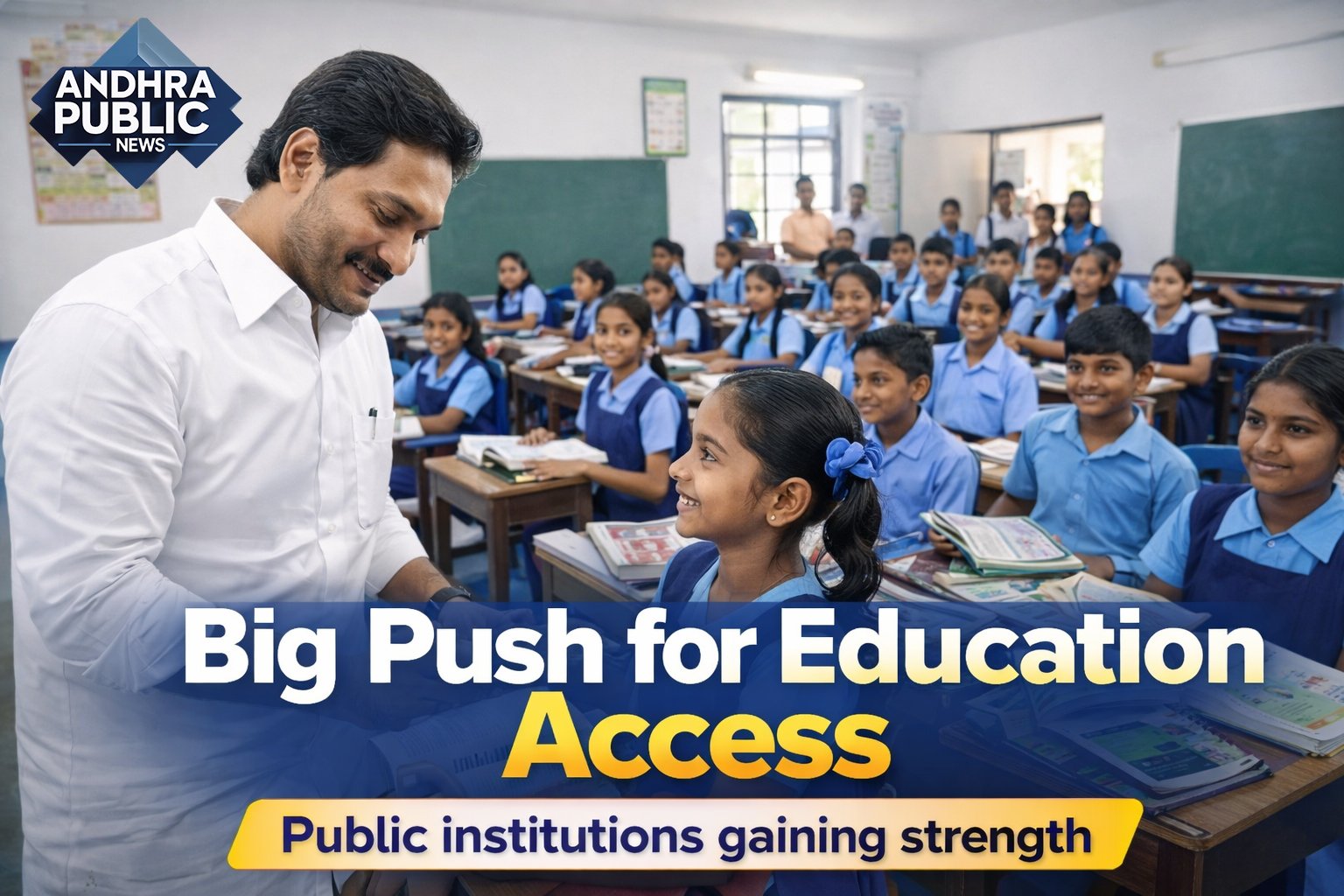
Observers highlight that modernization of classrooms, support for students, and expanded inclusion create psychological momentum. When parents perceive that public education is dependable, trust in institutions deepens. Such trust has cascading effects — enrollment rises, dropout rates decline, and community engagement improves. Over time, these changes strengthen democratic participation because educated citizens demand more accountability.
Importantly, educational reform also intersects with economic ambition. A state seeking industrial and technological growth must prepare its workforce accordingly. By prioritizing schooling and higher education access, the administration is effectively investing in future competitiveness. While fiscal discussions may focus on present expenditure, the more significant calculation lies in tomorrow’s capacity.
The political dimension cannot be ignored. Committing to education requires resilience because benefits may not align neatly with electoral cycles. By sustaining attention on this sector, Jagan Mohan Reddy’s leadership signals willingness to engage with governance beyond immediate visibility. Supporters argue that such continuity distinguishes policy from populism.
Still, challenges remain. Infrastructure expansion must be matched with teacher training, digital literacy, and evaluation frameworks. Quality assurance is essential to maintain credibility. As expectations grow, scrutiny will intensify, pushing the administration toward greater refinement.
Nevertheless, the broader narrative is clear: education is being positioned not merely as a service but as a transformative tool. Families that witness upward mobility through learning are likely to view governance with renewed optimism. Optimism, in turn, fuels cooperation and social harmony.
In this context, the educational agenda in Andhra Pradesh represents more than sectoral reform; it is part of a larger attempt to reshape the relationship between citizens and the state. By placing long-term human development at the center of political conversation, the YSRCP model under Jagan Mohan Reddy challenges the tendency toward short-termism.
Whether critics question pace or prioritization, the conversation itself marks progress. Education has moved from the margins of policy debate to its core. And that shift may ultimately prove to be one of the most enduring legacies of this period.